Showing posts with label Gay. Show all posts

Saturday, June 4, 2011

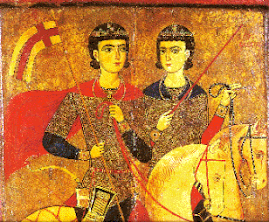
Monthly Chapel of Ss. Serge & Bacchus, Perpetua and Felicity Eucharist

This Sunday is Sunday after the Ascension: we will be celebrating the Mass of the Ascension and Extinguishing the Paschal Candle. The intent of the day is the Return to the Light. As Christ ascends to the Father, he also calls us to retun to the light.

"Our Lord, the joy of thy sweet cry has made us forget the life of this world, the sweetness of thy voice has made us remember the heavenly city. We rejoice as we ascend unto thee, Father with whom we have conquered in the land of darkness. O our great King, transport us to the city of the Angel-Gods, take us into the homes of rejoicing, for we are thine.Amen."

The lesson is taken from the Chaldean Oracles:

Let the immortal depths of the soul be opened, and open all thy eyes at once to the Above, for if the mortal draw near to the fire he shall have light from God. Thou shouldst speed to the light and to the rays of the Father. And when thou beholdest the most holy fire, flashing formless with dancing radiance through the depths of all the worlds, then listen to the voice of fire. Believe thyself to be out of body and so thou art; for divine things are not accessible to mortals who fix their minds on body; it is for those who strip themselves naked, who speed aloft to the height.

We look froward to seeing you there!

Rev's John & Donna, and Rev. Deacon's Gerry and Amber

Sunday, December 5, 2010

This Sunday, December 5th: The Chapel of Ss. Serge & Bacchus @ Ecclesia Gnostica Monthly Service

Second Sunday in Advent: Violet. Mass of same
Feast day of the H. Nicholas

THE LESSON

The lesson is taken from the writings of the Gnostic Fathers:

Cease to seek God in created things on the outside, but seek Him within thyself; and thus learn who it is that takes possession of thee and says: “My God, my consciousness, my understanding, my soul, my body.” Then learn whence is sorrow, and rejoicing, and love, and hate, and being awake, and being asleep, and getting angry against one’s will. Now if thou inquire into these things thou shalt find Him in thyself, one and many, like the atom, and thus thou shalt find the way out from thy lesser self.


We're at 3363 Glendale Blvd in Atwater Village (nearest cross street is Revere, Turn on Revere to enter parking lot from alley.plenty of parking!

Join our Facebook Group!

Sunday, February 22, 2009

Great Gay Quotes

It always seemed to me a bit pointless to disapprove of homosexuality. It's like disapproving of rain. - Francis Maude

In response to a reader who complained that a gay couple was moving in across the street and wanted to know what he could do to improve the quality of the neighborhood. 'You could move.' ~ Abigail Van Buren, "Dear Abby,"

The only queer people are those who don't love anybody. - Rita Mae Brown

My own belief is that there is hardly anyone whose sexual life, if it were broadcast, would not fill the world at large with surprise and horror. ~ W.Somerset Maugham

If homosexuality is a disease, let's all call in queer to work: "Hello. Can't work today, still queer." ~ Robin Tyler

I'd rather be black than gay because when you're black you don't have to tell your mother. ~ Charles Pierce

Why is it that, as a culture, we are more comfortable seeing two men holding guns than holding hands? ~ Ernest Gaines

The one bonus of not lifting the ban on gays in the military is that the next time the government mandates a draft we can all declare homosexuality instead of running off to Canada. - Lorne Bloch

You don't have to be straight to be in the military; you just have to be able to shoot straight. ~ Barry Goldwater

Drag is when a man wears everything a lesbian won't. - Author Unknown

My mother took me to a psychiatrist when I was fifteen because she thought I was a latent homosexual. There was nothing latent about it. - Amanda Bearse

I was standing in the middle of Manhattan, and heard a man say "They ought to take all these homos and put them on an island somewhere." I said, "Merry Christmas, Bozo, you're on it." - Jim David

(and, of course, the ever famous quote:) The Bible contains six admonishments to homosexuals and 362 admonishments to heterosexuals. That doesn't mean that God doesn't love heterosexuals. It's just that they need more supervision.

A NEW SPIRITUALITY FOR GAYS

article online at http://www.coolcatdaddy.com/cyrwyn/GaySpirituality.html

Here's a short excerpt from the article:

"With increasing documentation, gay historians and anthropologists are chronicling the lives of gay people within our culture and in other cultures of the past and present. There is a growing body of work demonstrating other cultural attitudes toward homosexuality and how gayness was integrated into those cultures. It appears that only late western culture since the eleventh century has been strongly homophobic. The ancient Greeks, founders of our way of thought, glorified homosexuality, although it had to fit a conventional, patriarchal social behavior. Neither did early Christianity condemn homosexual love, as is commonly but erroneously believed. Jesus spoke of the “Rache”, a derogatory Hebrew term for homosexuals, admonishing his followers not to condemn them. "

What does the Bible say about Homosexuality?

What does the Bible say about Homosexuality?

http://www.cathedralofhope.com


In our Judeo-Christian society, the documents known as the Bible serve as the primary guide on most issues. It is interesting that many Christians take literally the references to homosexual acts while interpreting other text with great flexibility. One person reported listening to a nationally known woman speak in her campaign against homosexuality. She spent much time quoting impressively from Leviticus. the listener accepted much of what the speaker had said until realizing that by Levitical standards, the crusader had herself broken many biblical laws; women speaking in church, women teaching men, wearing a dress made of cotton and polyester, and probably others of which he was unaware.

What does the Bible really say about homosexuality? Actually, very little. Jesus said nothing at all, which is most significant. Considering the relatively small amount of attention the Bible gives to the subject, we must ask ourselves why this is such a volatile issue while other subjects (e.g. judgment, pride, hypocrisy) about which the scriptures say a great deal, receive much less passionate attention. Before looking at specific passages, let us note that everyone understands the scriptures on and through the light of what they have been taught. The Bible was not written in a cultural void, and many of its instructions and laws we simply classify as less relevant today (e.g. prohibition of eating pork).

Nowhere in the Bible is the idea of persons being homosexual addressed. The statements are, without exception, directed to certain homosexual acts. Early writers had no understanding of homosexuality as a psycho-sexual orientation. That truth is a relatively recent discovery. The biblical authors were referring to homosexual acts performed by persons they assumed were heterosexuals.

The Sodom Story

A chief text for condemnation of homosexuality has been the Sodom story. This story has often been interpreted as showing God's abhorrence of homosexuality. In the story, two angels in the form of men were sent to Sodom to the home of Lot. While they were there, all the men of the city, "both young and old, surrounded the house --everyone without exception," and demanded that the visitors be brought out, "so that we might know them" (verse 5). Lot begged the men to leave his guests alone and take his daughters instead. The men of the city became angry and stormed the door. As a result, they were all struck blind by the angels.

There are several problems with the traditional interpretation of this passage. Whether or not the intent of the men of Sodom was sexual, the inhospitality and injustice coming from the mob and generally characterizing the community were "the sin of Sodom". Jesus himself refers to the inhospitality of Sodom. If, indeed, the men were homosexuals, then why would Lot offer them his daughters? What is threatened here is rape. The significant point then is that all rape is considered horrible by God. The story deserves another reading by all of us.

It should be noted that all of the men of Sodom could not have been homosexual or there would have been no need to destroy them since they would have all died off with no heirs. Quite likely they were a mixed group of evil men attempting to be abusive to people who were different. Ironically, lesbian and gay people are often the victim of that sin.

Although the traditional interpretation of the Sodom story fails as an argument against homosexuality, there are several other Old Testament passages which do condemn homosexual acts. Again, it should be noted that these passages do not deal with same-sex orientation, nor is there any references to genital love between lesbian or gay persons.

Homosexual Acts

Of thousands of Old Testament passages, only two make explicit reference to homosexual acts; Leviticus 18:22 and Leviticus 20:13. Both of these passages are a part of the Levitical holiness code which is not kept by any Christian group. If it were enforced, almost every Christian would be excommunicated or executed. It has been logically argued that science and progress have made many of the Levitical laws irrelevant for us. For example, Tim LaHaye states that, although Levitical laws prohibit intercourse during menstruation, medical authorities do not view it as harmful; and, therefore, it should not be viewed as sinful. He further explains, "those laws were given 3,500 years ago before showers and baths were convenient, before tampons, disinfectants, and other improved means of sanitation had been invented". With that, LaHaye makes this law irrelevant and rightly so. Ironically, though, in his book, The Unhappy Gay, the Levitical laws are one of the chief cornerstones. Much of the holiness code is now irrelevant for us as moral law. Thus, having children which was of exceptional importance to the early Hebrews is now made less relevant by overpopulation, just as the prohibition against eating pork and shell-fish has been made irrelevant by refrigeration.

The Bible never addresses the issue of homosexual love, but has several examples of same-sex love. David's love for Jonathan was said to exceed his love for women. Ruth's relationship with Naomi is certainly an example of a deep, bonding love. The Bible does value love between persons of the same sex.

Jesus' Attitude

In the context of the New Testament there is no record of Jesus saying anything about homosexuality. This ought to strike us as very odd in light of the great threat to Christianity, family life, and the American way that some would have us believe homosexuality is. Jesus saw injustice and religious hypocrisy as a far greater threat to the Realm of God.

Episcopal priest, Dr. Tom Horner has written the Gospels imply in two places that Jesus' attitude toward lesbians and gays would not have been hostile. The first is found in the story of Jesus healing the Centurion's servant. The word used for the servant is "pais" which in the Greek culture referred to a younger lover of an older more powerful or educated man. Clearly the story demonstrates an unusually intense love, and Jesus' response was wholly positive.

The other hint of Jesus' attitude is seen in his comments about eunuchs. Jesus opposed divorce in opposition to the abuses experienced by women. It is in the context of marriage which Jesus said that "some eunuchs were born so; others had been made eunuchs and still others choose to be eunuchs for the Kingdom's sake."

Jesus' remarks about celibacy and castration are clear, but a male child being born without testicles is a rare birth defect. It is only in our day that the Kinsey Institute has demonstrated that sexual orientation is likely determined prior to birth. It could well be that those to whom Jesus refers as being "born eunuchs" are the people we call lesbian or gay.

Jesus' attitude toward eunuchs differed greatly from the fundamentalist Pharisees of his day. To them, eunuchs were excluded from the covenant and barred from worship and participating in the community of faith. Jesus' graceful approach to eunuchs is beautifully pictured in the promise of the prophecy of Isaiah 56:4-8, "To the eunuchs...I will give them an everlasting name that will not be taken away."

In Jesus' day there were three types of persons called eunuchs: celibates, those who were slaves and were castrated so that children would not be born to them, and those who were "born eunuchs" or homosexuals. Royal and wealthy households would use castrated slaves to work with and guard the concubines and women slaves. However when assigning slaves to female members of the royal family they would choose homosexual slaves. With female members, the concern was not just unwanted pregnancies, but also rape.

It is against this background that we must read the story found in Acts 8:26-40. In this passage the Holy Spirit sends Philip the Deacon to witness to and baptize an Ethiopian eunuch of Queen Candace of Ethiopia. One of the earliest converts to Christianity was a person excluded for sexual reasons from the Old Testament community.

Paul's References

Paul's statement in Romans 1:18-32 has been taken as the strongest New Testament rejection of homosexuality. He is concerned about the influence of the pagan culture on the Roman Christians. After giving a detailed description of a world that "exchanged the truth of God for a lie, and worshipped and served created things rather than the Creator, " he continues, "Therefore, God gave them over to shameful lusts. Even their women exchanged natural relations for unnatural ones. In the same way the men also abandoned natural relations with women and were inflamed with lusts for one another. Men committed indecent acts with other men and received in themselves the due penalty of their perversion."

What Paul was referring to was homosexual temple prostitution which was performed by various cults (though far more cults used heterosexual prostitution). Again, Paul is not referring to same-sex love, and he clearly has no concept of persons for whom this lifestyle is "natural."

Paul's other reference to homosexual acts is similar to that of 1 Timothy 1:8-11. Both passages contain lists of persons to be excluded from the Realm of God. The interpretation of these passages depends on two Greek words which have always presented a problem for translators. In the King James Version, they are translated "effeminate" and "abusers of themselves with mankind." In the Revised Standard Version, they were combined and rendered homosexuals; however, these are not the Greek words for homosexual, so that translations reflects the scholars' bias. The New International Version illustrates the difference in these two words by translating them "male prostitute" and "homosexual offenders". The Jerusalem Bible uses the terms "catamites and "sodomites". Catamites were youth kept especially for sexual purpose; they were usually paid large sums of money. Neither passage refers to persons of same-sex orientation, but to people who used their sexuality for personal gain.

The Love of Christ

Jesus did a great deal to change many social customs and ideas. He elevated the position of women, and they were ultimately his best and most faithful disciples. He did this by example and by commandments which were absolutely inclusive of the rights of all people. Yet, in the name of the Christ whose love encompassed all, the Church has been the most homophobic of all institutions. This should not be surprising when we realize that the Church is still the largest institution which is primarily racially segregated.

The final and central message of he New Testament is that ALL persons are loved by God so much that God's Son was sent as a means of redemption from a disease by which we are all afflicted. The cure for this disease cannot be found in any set of actions. Neither homosexuality nor heterosexuality is redemptive. God's love through Christ was given to all people.

The Theological Reflection

For the Christian, sin must be understood as a disease which results FROM a broken relationship with God and which results IN a broken relationship with one another and with ourselves. Hence, Jesus' supreme command is to love God and to love our neighbors as we love ourselves. Christianity is not a religion with new rules and laws, but is rather a new relationship with God. Those things which the legalists are fond of labeling "sins" are actually just symptoms of the much deeper disease of alienation and estrangement. Much of the energy of the Church has been spent dealing with symptoms while leaving the disease intact. Jesus did not seem overly concerned about the legal transgressions of those to whom he ministered. Rather, he was much more concerned with healing the physical, spiritual, emotional, or relational brokenness of people. Perhaps if the Church would again give itself to the healing/reconciling ministry of Jesus, then some of the symptoms about which we are so concerned would begin to disappear.

That brings us to the question: Is homosexuality a symptom of brokenness? In some few cases perhaps so. Yet, obviously pointing fingers of blame and accusation is not Christ's way. Rather, Jesus accepted people as they were and allowed love and acceptance to work its miracle. However, most lesbians and gays have been lesbian or gay for as long as they can remember. For them, it is a much a natural characteristic as their eye color or their handedness. Kinsey Institute research has suggested that homosexuality may well be genetic or a least linked to some prenatal factors. Certainly most competent psychologists would concur that sexual orientation is set prior to the age of five in most persons. It is, therefore, not a matter of choice, so it cannot be a moral or ethical issue.

Many Christians insist that God can change/cure the homosexual. In the book, The Third Sex, there are six reported cases of homosexuals whom God has "cured". Of these six, at least four are known to have returned to their gay life style. Many lesbians and gays spend most of their lives trying, with no success, to persuade God to change them. It is like trying to get God to change your eye color. What option then is left to these persons? They have been told that they can't be gay and be Christians; and since all efforts have failed in their struggle not to be gay or lesbian, then their only recourse, according to the Church, is that they can't be Christian. So the Church has discounted or discarded as much as 10% of the population.

If they are excluded from the life of the Christian community, who then will tell them of God's inclusive love and of Jesus' reconciling death? Are they left to assume that God is so narrow-minded as to exclude them for something over which they have no control and for a choice they did not make? When will the Church finally be brave enough to say with Paul, "in Christ there is neither Jew or Greek, slave or free, male or female," gay or straight. God has enough love for all!

Rev. Michael Piazza

Gay Religious Humor: Rings a Bell?

Gay Religious Humor: Rings a Bell?

Twelve priests were about to be ordained. The final test was for them to line up in a straight row totally nude in a garden while a beautiful, big breasted, nude model danced before them. Each priest had a small bell attached to his manhood, and they were told that anyone whose bell rang when she danced in front of them would not be ordained because he had not reached a state of spiritual purity.

The beautiful model danced before the first candidate, with no reaction. She proceeded down the line with the same response from all the priests until she got to the final priest, Carlos. As she danced, his bell began to ring so loudly that it flew off and fell clattering to the ground. Embarrassed, Carlos took a few steps forward, and bent over to pick the bell up.

Then all the other bells began to ring.

Was Jesus Gay? Bishop Robinson challenges evangelical views on the family

http://www.ekklesia.co.uk/content/news_syndication/article_05044family.shtml

An Anglican bishop has sparked outrage by suggesting that Jesus challenged what many evangelicals see as traditional models of the family.

Some conservatives have even interpreted his comments as a suggestion that Jesus was gay.

The Rt Rev Gene Robinson, the Bishop of New Hampshire in the Episcopal Church of the United States, pointed out that Jesus was an unmarried, "non-traditional man" who did not uphold family values, "travelled with a bunch of men" and enjoyed an especially close relationship with one of his disciples.

His comments, made in a recent address at the Christ Church of Hamilton and Wenham in Massachusetts, have enraged traditional Anglicans, some of whom have interpreted his comments as a suggestion that Jesus was gay, and said the Bishop should be "struck down by thunder and lightning bolts".

Bishop Robinson, whose consecration in 2003 contributed to a schism between some evangelicals and liberals in the worldwide Anglican Communion, was giving an address entitled "Homosexuality and the Body of Christ: Is There a New Way?"

In answer to a question from the congregation about how the acceptance of homosexuality could be squared with the scriptural emphasis on redemption for sins, the Bishop replied: "Interestingly enough, in this day of traditional family values, this man that we follow was single, as far as we know, travelled with a bunch of men, had a disciple who was known as 'the one whom Jesus loved' and said my family is not my mother and father, my family is those who do the will of God. None of us likes those harsh words. That's who Jesus is, that's who he was at heart, in his earthly life.

"Those who would posit the nuclear family as the be all and end all of God's creation probably don't find that much in the gospels to support it," he said.

David Virtue, a conservative evangelical commentator who runs the website, VirtueOnline, called the comments "rubbish", despite the fact the bishop's arguments were based on a reading of scripture.

He said: "It is appalling deconstructionism from the liberal lobby which will spin even the remotest thing to turn it into a hint that Biblical figures are gay. It is so utterly preposterous to imply that Jesus's relationship with John was homo-erotic, but twisting the truth is the only way these people can get scriptural justification for their lifestyles. Can you imagine Calvin, Luther or Erasmus saying something like this? It is a wonder that thunder and lightning bolts don't strike Bishop Robinson down."

Canon Chris Sugden, a spokesman for the evangelical organisation, Anglican Mainstream, said: "He's really selective in what he's addressing. He makes no mention of Jesus's teaching on marriage, for instance. And he does not acknowledge that nowhere in the text or in ancient literature is there any suggestion of any form of sexual impropriety among Jesus or the disciples. Jesus broke the cultural traditions of the time and has women mixing with men in public and having them teaching. Those of us who put scripture as a priority are called on to obey the scripture even when that is in conflict with our culture.

"Bishop Robinson is saying that the culture has moved in his direction and that it's all becoming accepted, so he's looking for ways to interpret scripture to support that instead of realising that scripture asks us to do the unpopular thing and stand against the prevailing culture."

Mike Barwell, a spokesman for Bishop Robinson, said: "Jesus was a non-traditional person who broke all the rules and hung out with all the wrong people. Anything else that people infer from the Bishop's comments is all speculation."

The views expressed in this article do not necessarily represent the views of Ekklesia

Discuss Send to a friend Daily email

Can Religion Change Your Sexuality?

Perspectives - Vol. 1, No. 3 - Can Religion Change Your Sexuality?
http://www.mentalhelp.net/poc/view_doc.php?type=doc&id=283

Barb Chandler

Recently there has been increasing attention to support groups that promote change from homosexual to heterosexual behavior. These ex-gay ministries have been around for years, however, with the advent of 'the moral majority', 'traditional family values', and other values promoted by the religious right, they have become much more widespread.

My partner and I heard a testimonial from an ex- lesbian. She said that she has attended to a church-sponsored support group, and was 'in recovery' from her lesbianism. Her story was entwined with the familiar assumptions that those who are anti-gay pronounce with undaunting authority.

This women said that she came from a dysfunctional home. Her mother was an alcoholic and, her father sexually abused her. She became very depressed, and was suicidal. Her sister, who was lesbian, suggested that she visit a gay/lesbian bar. She did, and liked it. To be 'in' with the crowd, she cut her hair short, bought a motorcycle and a pickup, donned leather apparel, and thus made her entrance into the bar scene. She turned to drugs and alcohol, went through many relationships, and hit bottom. She begin a relationship with a woman who would turn her life around. Both of them decided that they needed to turn to God for help since they felt that their lesbianism was at the root of their depression. They begin to go to church, and found a support group that made the claim to heal people of their homosexuality. They went, and made the choice to stop being sexual with one another. They wanted to maintain their emotional relationship, and continue to live together. However, a woman from the support group told them that they needed to live separately. They both decided that this was for the best, and, after a tearful goodbye they separated. The speaker said that her 'recovery from lesbianism' is a constant struggle, which she maintains by continuing to go to 'counseling', praying for God to heal her of her lesbianism, and removing herself from temptation.

I found this testimonial to had quite an emotional impact upon me. Actually encountering a person face to face who believes her lesbianism is evil, and is a 'continual struggle', was a definite trigger for me. I was saddened by the fact that people who are anti-gay/lesbian find it necessary to project their distaste upon others, and claim that their way is the only moral way. I wondered how the talk would impact those people who may be struggling with personal issues regarding homosexuality. Would they be vulnerable to 'conversion' groups. Instead, I hoped that they can reconcile their homosexuality with their spirituality, and if not, then will look for a group which will give them positive support.

The generalizations in this woman's testimonial was, in my experience, a prime example of the assumptions that some ministers, priests, and facilitators of support groups commonly make. They see homosexuality from a pathological standpoint, are convinced that homosexuality is inherently evil and is against God's plan for humankind. They believe it is their 'Christian' duty to change people who exhibit homosexual behavior to heterosexual. Not only is this a waste of time and money, but it can prove psychologically damaging. Treatment takes many different forms; counseling, psychotherapy, aversion therapy, support groups, exorcism and prayer. The assumptions underlying treatment is that God thinks homosexuality is wrong because this is what the Bible says. Therefore, as long as the person is willing to repent of their homosexuality, God will heal them. In addition, these people think that sexual orientation is a matter of choice, and can be easily changed. Research findings suggest that efforts to change homosexuals are nothing more than a social prejudice garbed in psychological language.

Perhaps the strongest testimonial of what a negative impact counseling to change one's homosexuality has on a person's life is an autobiography by Mel White, the gay man who did ghostwriting for the likes such as Jerry Falwell and Pat Robinson. Mel was raised as an evangelical, the church which typically encourages ministries as counseling homosexual's to change their orientation. He discovered he was gay early in his life. The book details the extremes he went through to try to avoid his homosexuality. He tried, very unsuccessfully to be heterosexual by getting married and having children, went through years and years of therapy, shock treatments, depression, despair, suicidal thinking, and promiscuity. It was not until he accepted his homosexuality that he begin to lead a happy life. He is now a very strong advocate of gay and lesbian rights, and is the Dean of The Cathedral of Hope MCC/Dallas.

Mel's reactions to his homosexuality seems to be a very typical response of a person who has been raised hearing about how God considers homosexuality to be an abomination, and how society considers those who are homosexual as 'perverts' and 'sexual deviants'. A person is apt to hide their sexual orientation from their relatives, friends, and sometimes even from themselves. They strive to find a quick fix to the emotional pain and conflict they are in. It is this attitude that these groups appeal too, with their false promise of everything being all better once you repent of your homosexuality. Besides the promise of 'quick fix', gaining acceptance and support of the group has alot of appeal to a person who believes they need this type of acceptance and support.

There are general characteristics that groups such as these have. They often use manipulation, fear, and deception to maintain a hold on members. They often shower the members with unbelievable amounts of affection and approval for staying in the group and meeting their expectations, which is called love-bombing. Groups also control and distort information from the outside. Thus it becomes a sin to read any 'worldly' publications or 'spiritual pornography'. These groups make an extremely sharp distinction between right and wrong, good and evil; everything in the group is positive, godly, and everything outside is negative, satanic. Ambiguity, doubts, and serious questions are not tolerated. The authority of the group's leadership is virtually absolute. All problems are oversimplified and deflected either away from the group or back towards the individual. Trying to change a person's God given sexuality is not only very unethical, since the counselor relies on their own agenda rather than the client's, it can become deadly. For example; the National Institute of Health reports that 'about 30% of youth suicides are by gay and lesbian people who recognize that they are homosexual and realize that they cannot change their sexual orientation'. There are professional organizations that have spoken out against the practice of categorizing homosexuality as moral depravity or mental illness. The American Psychological Association released a statement on homosexuality in July 1994. "The research on homosexuality is very clear. Homosexuality is neither mental illness nor moral depravity. It is simply the way a minority of our population expresses human love and sexuality. Study after study documents the mental health of gay men and lesbians. Studies of judgment, stability, reliability, social and vocational adaptiveness all show that gay men and lesbians function every bit as well as heterosexuals. In August of 1994, the American Psychological Association sent a proposal to one of its committees that would declare as unethical: attempts by a psychologist to change a person's sexual orientation through therapy, referral of a patient to a therapist or organization who attempts to change people's sexual orientation". The American Medical Association released a report in December 1994 which calls for "nonjudgmental recognition of sexual orientation by physicians. Finally, the American Psychiatric Association took homosexuality off of its list of mental illnesses many decades ago.

I hope that through this expose clergy and pastoral counselors will become aware of the influence that these ex-gay/lesbian ministries have upon the spiritual and psychological lives of gays and lesbians. If any of you reading this article are struggling with spiritual issues regarding your homosexuality there are many organizations that you can turn to for help. Most mainstream churches have gay and lesbian ministries that celebrate homosexuality as God's gift, and are advocating for equal rights for gays and lesbians.

A Resource List

Books

* Stranger At The Gate. To Be Gay and Christian in America, Mel White, 1994.

* Is The Homosexual My Neighbor? Another Christian View, Letha Scanzoni and Virginia Mollenkott, 1978.

* Ex-gays? There Are None! What It Means To Be A New Creature In Christ, Sylvia Pennington, 1989.

* A Complete Workbook for Demystifying the Bible's Position on Homosexuality. Torrey Stuart

Barb Chandler is a regular contributor to "Perspectives".

Reference
Chandler, Barb (1996). Can religion change your sexuality? [Online]. Perspectives. [1996, July 15].